
24.11.2015
Nature Nanotechnology Paper: Conductance switching in single-molecule junctions
Field-induced conductance switching by charge-state alternation in organometallic single-molecule junctions
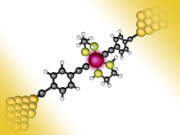
In a recent paper in the peer-reviewed journal  Nature Nanotechnology, scientists at IBM Research Zurich, the University of Zurich, and the University of Vienna (now TU Wien) are reporting on a novel concept to modulate the current through a less-than-3 nm long molecule by more than three orders of magnitude – a critical step to control transport for future electric circuits, with applications in signal processing, logic data manipulation, data storage or neuromorphic networks. Futhermore, the charge-state of this small organometallic molecule can be addressed solely by the external field present in a simple two terminal geometry (a gate electrode is not required).
Calculations performed on the Vienna Scientific Cluster (VSC) by Robert Stadler (formerly at the University of Vienna, now at TU Wien) and his PhD-student Georg Kastlunger within the VSC Project "Electrochemical charge transport" provided a microscopic picture of the underlying process: The molybdenum atom, sitting in the centre of the organometallic molecule, has a spin-polarized ground state which creates a localized molecular orbital. Simply adding one extra charge onto the molybdenum atom gives the huge change in conductance. So it is a quantum mechanical effect that allows to create a highly functional molecule acting as an efficient current switch and storage element with unprecedented performance.
IBM Research Blog: Field-induced conductance switching
Press release: The switch molecule (english)Press release: Das Schalter-Molekül (german)Molekularer Transistor entwickelt, der mit nur einem Elektron schaltet (german)Molekularer Transistor schaltet mit nur einem Elektron (german)Das Schalter-Molekül (german)
(Announcement posted on 24.11.2015.)