
MUSICA

MUSICA (Multi-Site Computer Austria) is the latest addition to Austria's national supercomputing infrastructure. The system's compute resources are distributed across three locations: in Vienna, Innsbruck, and Linz.
The system comprises a total of 440 compute nodes, all featuring direct liquid cooling.
VSC-5
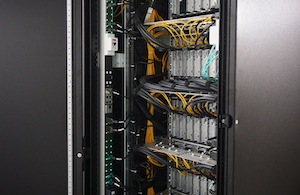
VSC-5 is the latest addition to the Vienna Scientific Cluster infrastructure, supplied by  MegwareAMD EPYC Milan
The CPU partition of VSC-5 achieves a benchmark value (Rmax) of 2.31 PFlop/s and in addition the GPU partition delivers about 1 PFlop/s.
VSC-4
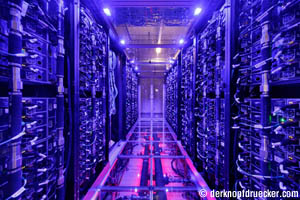
At the time of its launch, VSC-4 was the most powerful supercomputer ever installed in Austria, reaching a performance (Rmax) of 2.7 PFlop/s, with the theoretical peak performance Rpeak being 3.7 PFlop/s. The system consists of 790 water cooled nodes (Lenovo SD650), each with two Intel Skylake Platinum 8174 processors with 24 cores, interconnected with 100 Gbit/s OmniPath.
VSC-4 was installed in summer 2019 at the Arsenal TU building (Objekt 214) in Vienna by EDV-Design
LEONARDO – available for Austrian users
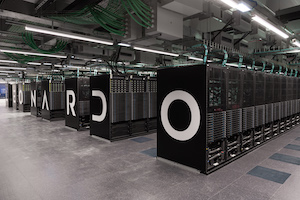
© Giacomo Maestri
The EuroHPC system
Austrian researchers can apply for compute time at LEONARDO via the national AURELEO Calls.
VSC-3 – retired
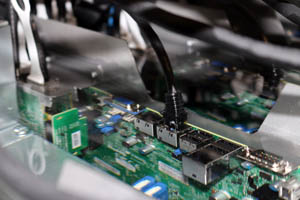
VSC-3 retired in May 2021. Its extension VSC-3+ went out of service in October 2022.
VSC-3 was a throughput-oriented general-purpose Linux cluster with 864 compute nodes (in the VSC-3+ partition), several GPU partitions, and the bioinformatics nodes with extra large RAM.
VSC-3 was installed in summer 2014 and got a significant extension called VSC-3+ in June 2018.
VSC-2 – retired
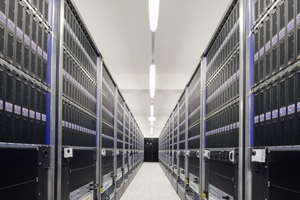
VSC-2 is retired, it went out of service by the end of December 2018.
VSC-2 was installed in May 2011 at the Arsenal TU building (Objekt 214) in Vienna by MEGWARE
It consisted of 1314 nodes, each with 2 processors (AMD Opteron 6132 HE, 2.2 GHz, 8 cores) with QDR InfiniBand.
VSC-1 – retired
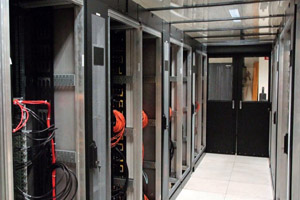
VSC-1 is retired, it went out of service by the end of March 2015.
VSC-1 was set up in 2009 with an investment of almost 2 million Euros. It was located in the Freihaus building of TU Wien and ranked 156th in the November 2009 TOP500 list.