
15.02.2018
Nature Communications Paper: Controlling quantum interactions in a single material
Tunable metal-insulator transition, Rashba effect and Weyl Fermions in a relativistic charge-ordered ferroelectric oxide (Ag2BiO3)
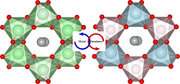
Materials with controllable quantum mechanical properties are of great importance for the electronics and quantum computers of the future. However, finding or designing realistic materials that actually have these effects is a big challenge.
Next generation electronics and quantum computers rely on materials that exhibit quantum-mechanical phenomena and related properties, which can be controlled by external stimuli, e.g., by a battery in a microelectronic circuit. Quantum mechanics governs, for example, how fast –and if at all– electrons can move through a material and, thereby, determines whether the material is a metal which conducts an electric current or whether it is an insulator which cannot conduct a current. Furthermore, the interaction of the electrons with the crystal structure controls whether a material can be ferroelectric. In this case one can switch between two electric orientations by applying an external electric field. The possibility to activate multiple quantum-mechanical properties in one single material is of fundamental scientific interest but can also expand the spectrum of potential applications.
In a recent paper in the peer-reviewed journal  Nature Communications, an international team of researchers led by Cesare Franchini and Jiangang He of the Quantum Materials Modelling Group at the University of Vienna, in cooperation with James Rondinelli of Northwestern University and Xing-Qiu Chen of the Chinese Academy of Science has now demonstrated for the first time that multiple quantum interactions can, indeed, coexist in a single material and that it is possible to tune between them with an electric field. "This is like awakening different kinds of quantum interactions that are quietly sleeping in the same house without knowing each other", explains Cesare Franchini.
For their discovery the scientists solved the relativistic form of the Schrödinger equation, by performing computer simulations on the Vienna Scientific Cluster (VSC Project "INDOX"). The material of their choice, the compound Ag2BiO3, is exceptional for two reasons; on the one hand it is composed of the heavy element bismuth, which allows the spin of the electron to interact with its own motion (spin-orbit coupling) – a feature that has no analogy in classical physics. On the other hand, its crystal structure does not exhibit inversion symmetry, suggesting that ferroelectricity could occur. The application of an electric field to the oxide Ag2BiO3 changes the atomic positions and determines whether the spins are coupled in pairs (forming so-called Weyl-fermions) or separated (Rashba-splitting), and whether the material is electrically conductive or not.
"We have found the first real case of a topological quantum transition from a ferroelectric insulator to a non-ferroelectric semi-metal", states Cesare Franchini. The spin-orbit coupling is of fundamental importance, as it can yield the formation of novel quantum states of matter, and represents one of the hottest research area in modern physics. Also in view of potential applications, there are promising prospects: the control over quantum interactions in a real material could enable ultrafast, low-power electronics and quantum computers for qualitative leaps forward in data acquisition, data processing, and data exchange.
VIEW-ONLINE PDF of the article in Nature Communications
Controlling Quantum Interactions in a Single Material, McCormick School, NWU 2018-02-05Controlling quantum interactions in a single material, phys.org 2018-02-05Controlling Quantum Interactions in a Single Material, rdmag.com 2018-02-05Controlling quantum interactions in a single material, sciencedaily.com 2018-02-05Controlling Quantum Interactions in a Single Material, sciencenewsline.com 2018-02-05Controlling quantum interactions in a single material, eurekalert.org 2018-02-05Controlling quantum interactions in a single material, nanowerk.com 2018-02-05Controlling quantum interactions in a single material, brightsurf.com 2018-02-05Controlling Quantum Interactions in a Single Material, pddnet.com 2018-02-06Press release: Schrödinger-Gleichung als Quantenwecker (german), Universität Wien 2018-02-07Schrödinger-Gleichung als Quantenwecker (german), monitor.at 2018-02-07Schrödinger-Gleichung als Quantenwecker (german), APA science 2018-02-07Zwischen Isolator und Leiter - Forscher fanden umschaltbares Material (german), APA science 2018-02-07Umschaltbar: Material wird vom Isolator zum Leiter (german), futurezone.at/ 2018-02-07Umschaltbar: Material kann Leiter oder Isolator sein (german), derstandard.at 2018-02-08The Schrödinger equation as a Quantum clock, chemeurope.com 2018-02-13
(Announcement posted on 15.02.2018.)