
09.04.2022
CFD training for the hydropower sector
In this successful cooperation between academia and industry, engineers from Austrian SMEs practiced numerical flow simulations on the Vienna Scientific Cluster. The knowledge gained will help the companies improve the efficiency of hydropower plants.
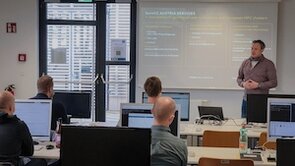
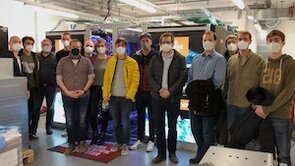
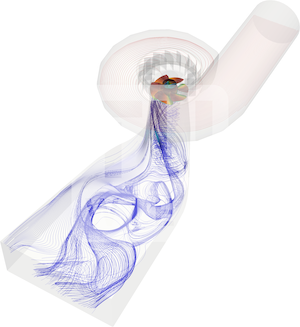
On 21-25 March 2022, five Austrian companies from the field of hydropower plant construction and operation participated in a training in computational fluid dynamics (CFD) at TU Wien. The aim was to use numerical flow simulations to simulate the parts of a hydroelectric power plant under the greatest stress, such as a turbine or impeller, with open-source software (OpenFOAM and Paraview).
The training took place in the context of the innovation camp  WakaSiThe Austrian Institute of Energy Systems and ThermodynamicsEuroCC Austria
Supercomputing for first-time users
CFD applications require much computing power and are most efficiently run on high-performance computing (HPC) systems with large throughput local storage, low latency networks, and optimized CPUs. Because the participants of the innovation camp had never used HPC before, an additional workshop on HPC and using HPC systems such as VSC clusters was an important part of the training.
It soon became clear, however, that the traditional HPC workflow would pose an entry hurdle for the participants. Conventionally, one would have to create a model on a local machine, check the mesh for inconsistencies, set the appropriate boundary conditions and parameters and only then send the resulting file to the supercomputer, write a job script, submit the job, transfer the outcome back to the local machine in order to visualize and interpret the results.
To cater for a convenient work environment on the HPC systems, the technical team provided
GPU-accelerated rack workstations on VSC-4 for the training. This enabled the participants to run their simulations entirely on the supercomputer. Thanks to the GPUs in the rack workstations, the graphical output was fluid. It was the first time that the rack workstations were used in a larger training event, and the VSC staff did everything possible for it to go smoothly.
Gained know-how in CFD and HPC
As a result of the five-day training, the participants not only mastered flow simulations but also acquired skills in supercomputing, got acquainted with workflows on VSC and learned how to speed up the simulations and harness the full power of the HPC system with parallelisation across multiple nodes.
Powered by supercomputing, CFD simulations help find solution-oriented and cost-effective answers to flow engineering problems much faster, which is an essential competitive factor for businesses. Participating in the knowledge transfer with the experts at TU Wien was therefore an important investment for the companies that should help them optimise hydroelectric power plants and create innovative solutions for renewable energy.
The VSC team thanks Bernhard Semlitsch and EuroCC Austria for the successful collaboration and thanks the companies gbd Hydro ZT GmbHVoith HydroGUGLER Water Turbines GmbHGlobal Hydro EnergyGeppert Hydropower
(Announcement first posted on 09.04.2022.)