
29.09.2023
10th anniversary of the VSC Research Center
Celebrating a decade of leadership in High-Performance Computing (HPC) in Austria.
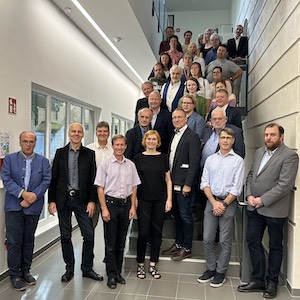
In September 2023, the VSC Research Center had its 10th anniversary. The VSC steering committee, together with the VSC team and honored guests, gathered to celebrate the new milestone, sharing a retrospective and an outlook on the future of the Vienna Scientific Cluster (VSC).
The origins of the VSC Research Center
Back in 2013, the Vienna Scientific Cluster was a modest high-performance computing (HPC) infrastructure supported by the University of Vienna and TU Wien as owners with a partnership of the University of Natural Resources and Life Sciences (BOKU) Vienna.
As Johannes Fröhlich, former Vice-Rector for Research at TU Wien, recollects, it was of the highest importance to bundle forces to scale the project and include more universities in the VSC operations. Soon after TU Graz and the University of Innsbruck joined the VSC consortium, the VSC Research Center was founded as a service unit to support HPC users, provide training, and facilitate the use of HPC.
The VSC Research Center was built up and successfully led by Herbert Störi (TU Wien). In 2022, the leading role was transferred to Andreas Rauber (TU Wien). The acquisition and further development of the HPC infrastructure is coordinated by Ernst Haunschmid (VSC team at TU Wien) as tech lead.
VSC today
Hosting the most powerful supercomputers in Austria, VSC has become a cornerstone of scientific research. The VSC infrastructure has enabled successful research initiatives and projects in various domains, including areas that have not traditionally made use of HPC, such as the digital humanities. "New artificial intelligence methods will reinforce this trend", says Christoph Dellago (member of the VSC steering committee, University of Vienna), "and will further increase the need for HPC facilities such as the VSC."
Apart from the hardware side of things, Dellago praises the valuable training activities of the VSC Research Center that cater to both HPC newcomers and experienced users, helping them maximize benefits of HPC. The training program led by Claudia Blaas-Schenner (VSC team at TU Wien) since 2016 has been an enormous success that made the VSC Research Center a flagship training center for HPC in Europe.
Through training and other activities, the VSC Research Center has been active internationally and forged essential partnerships with the MPI community and networks such as PRACE, EuroHPC Joint Undertaking, and EUMaster4HPC.
The VSC consortium now unites six Austrian universities: TU Wien, University of Vienna, University of Natural Resources and Life Sciences Vienna, Graz University of Technology, University of Innsbruck, and Johannes Kepler University Linz.
Outlook
Building on the achievements of the past years, the VSC Research Center looks ahead to the next decade of productive collaboration with the consortium partners, with a particular focus on expanding the infrastructure through the MUSICA project.
Sharing the outlook into the future, Manfred Stepponat (member of the VSC steering committee, TU Graz) shares the commitment of the VSC consortium to continue to provide efficiently usable, state-of-the-art HPC resources, further develop IT-based tools from the Open Source community, and promote digital sovereignty in university research.