29.06.2023
Climate modeling on VSC – access for students
Students at the University of Vienna receive access to the VSC supercomputer to run complex global climate models.
When simulating complex climate models, researchers are often faced with the problem that it is not possible to limit the models to smaller regions in order to save computing power and memory load. High-performance computing (HPC) is therefore essential for most modern climate models, especially those that simulate the entire globe.
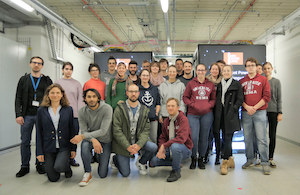
To learn first-hand how to run and optimize the simulations with HPC, students at the Department of Meteorology and Geophysics (University of Vienna) had an opportunity to access VSC during the course  Modelling and Data Analysis.
In the course led by Marina Dütsch, Lukas Brunner, and Daria Tatsii, the students learned the prerequisites to run and analyze a global climate model, including how to use server-based Linux systems, version control, basics of slurm, domain-specific data formats such as NetCDF, and tools such as the Climate Data Operators (CDO).
VSC access
On the VSC, the task for the students was to set up and configure the Community Earth System Model Version 2
(CESM2), a state-of-the-art climate model.
Each student got a temporary account on VSC, where they cloned and configured CESM2. After a short test simulation, the course participants independently ran three 10-years simulations:
- a baseline simulation with fixed ocean temperatures
- an intervention simulation with four times elevated CO2 concentration
- another intervention simulation with ocean temperatures increased by 4K
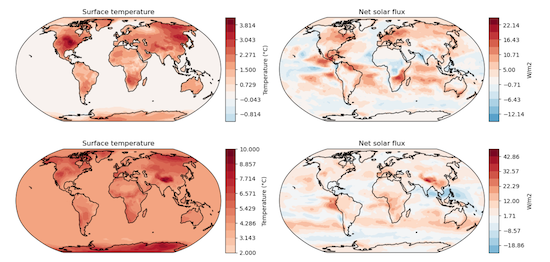
Subsequently, the students investigated differences between the baseline simulation and the intervention runs. The dramatic effects according to the CESM2 model can be seen in the figure below. “We appreciate the uncomplicated way everything was set up for the students. Having access to the compute nodes of the VSC and being able to run a global climate model themselves gave them a unique insight into the world of high-performance computing,” was a positive feedback from Marina Dütsch.
Facilitated by EuroCC Austria – National Competence Centre for Supercomputing, Big Data and Artificial Intelligence, VSC is providing students with access to supercomputing resources. Together, VSC and EuroCC Austria support the next generation of HPC users confident in using state-of-the-art tools for tackling complex problems in climate research and other fields of science.