
30.04.2025
AI-based forecasting for safer, greener shipping
Greek startup AlongRoute developed an AI model to predict wave heights in seas and oceans with high precision — powered by Austria’s VSC supercomputer.
Maritime transport is responsible for nearly 3% of global CO₂ emissions — a figure expected to rise significantly in coming decades. But there is an efficient way to cut emissions: detect adverse weather conditions as early as possible, adjust routes accordingly, and save fuel. This approach isn’t new — but current weather-based routing systems have a major shortcoming: inaccuracy. They struggle to reflect the chaotic, complex nature of the ocean with any precision. That’s why better forecasting models are urgently needed.
For ship operators, this means higher fuel consumption, increased costs, and greater risk to crews and cargo during adverse weather conditions.
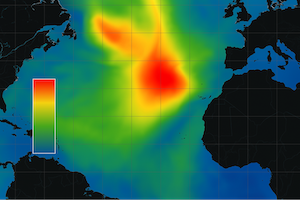
The model can predict significant wave height with an average mean absolute error of 0.34 m compared to reanalysis data. © AlongRoute
The solution: AI-powered wave height prediction
Greek startup AlongRoute, in collaboration with AI company Neuralio and supported by the competence center EuroCC Austria, developed a deep learning model to forecast Significant Wave Height (SWH) — a key parameter for safe and efficient navigation. The goal: enable route optimization systems to respond earlier and more precisely to changing sea conditions.
Their model, based on a hybrid of Graph Neural Networks and Gated Recurrent Units, achieved high accuracy across 6-, 12-, 18-, and 24-hour forecasts using data from Copernicus marine services.
Role of VSC
To train the AI model effectively, AlongRoute needed to process over 500 million data points — far beyond the capacity of standard cloud resources. The project was moved to VSC-5, Austria’s flagship high-performance computing system, with the support of EuroCC Austria.
On the VSC-5, training was completed in just under 14 hours using two NVIDIA A100 GPUs with 512 GB RAM each. The system’s parallelization capabilities and large memory enabled the team to load and process the full dataset at once — avoiding the performance bottlenecks experienced on smaller systems.
“Using the VSC-5’s computing power allowed us to optimise our AI workload and train our model far more efficiently than before,” said Vasilis Alexandridis, CTO of AlongRoute.
From research to real-world application
The final model achieved a mean absolute error of just 7 mm and an R² score of 0.98, outperforming existing forecasting systems, especially under rough sea conditions. AlongRoute is now integrating its forecasts into maritime navigation tools, helping clients optimize routes, reduce emissions, and improve safety at sea.
A pilot project with route optimization provider VesselFront is already underway: AlongRoute will provide marine weather data for the Atlantic, Indian Ocean and Mediterranean, which will be directly integrated into ship navigation systems.
Success story by EuroCC Austria
Open access article HPC-Driven Oceanographic Predictions with Graph Neural Networks (GNNs) and Gated Recurrent Units (GRUs)
(Announcement first posted on 30.04.2025.)