
22.03.2025
Climate modeling with HPC – access for students
Meteorology students at the University of Vienna get introduced to high-performance computing with the VSC supercomputer.
Article by Blaž Gasparini, Senior Scientist at the University of Vienna, Institute for Meteorology and Geophysics.
Climate models are an essential part of modern society: Their results shape future scenarios, inform policy targets, and guide scientific discussions. Yet, for many people — including some climate scientists — these models remain mysterious black boxes. An ongoing collaboration between the Department of Meteorology and Geophysics at the University of Vienna and the Vienna Scientific Cluster (VSC) allows students to go beyond theory and run their first climate model simulations on a supercomputer.
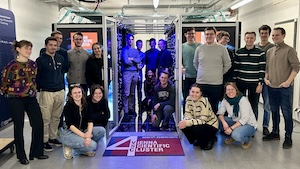
The students thoroughly inspected VSC-4 on which they ran their own climate model simulations © VSC team
Hands-on experience on VSC-4
In the "Modeling and Data Analysis" class led by Blaž Gasparini the students received a trainee access to VSC-4, one of Austria's flagship supercomputers. Working directly on the supercomputer, the learning curve was steep — especially when the ongoing meteorologists encountered cryptic error messages while compiling model code or submitting jobs to the queue. But the students persevered, and in the end, each of them successfully ran their own climate simulations.
They worked with ICON, a highly versatile atmospheric model used for both weather forecasting and climate projections. After navigating the complexities of running the model and processing output files, the students were relieved to find that their simulated present-day climate actually resembled the real world. Given that ICON is a 400,000-line beast of a model, their initial skepticism was understandable.
Investigating global warming in a real-world context
After that, the fun part began: Instead of just analyzing pre-existing datasets, students tackled a real scientific question using their own climate model experiments: How much of global warming is due to the direct radiative impact of greenhouse gases versus the resulting increase in surface temperature? In reality, these effects are intertwined, making it difficult to separate them. But this is where climate models are indispensable — they let us ask "what if" questions and isolate specific processes.
The students ran two simulations: one where only greenhouse gases increased (without changing surface temperatures), and another where surface temperatures were artificially raised by 4°C. The first experiment showed only minor climate changes, while the second revealed dramatic shifts. In particular, they noticed that the troposphere — the atmospheric layer where weather happens — expanded in a warmer world. Thunderstorm clouds and other cloud layers formed at higher altitudes.
Increasing demand for the course
Ultimately, hands-on experience makes climate science more accessible. This year even more students joined the course than last year, showing a growing interest in scientific computing. Who knows — maybe some of them will push the boundaries of computational climate science in the near future!
A visit to VSC
To make the experience even more tangible, the students also had the opportunity to visit the VSC and see firsthand the high-performance computing cluster on which they ran their simulations. Seeing the physical infrastructure behind their work was a particularly memorable moment that was possible through the VSC team who opened the gates for the students.
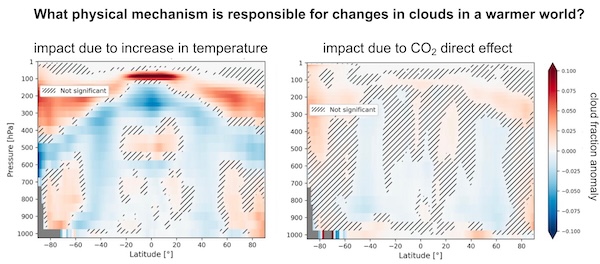
Cloud fraction anomalies using ICON climate model simulations. Left: anomalies between an increased surface temperature simulation and the present-day climate simulation. Right: anomalies between an increased CO2 simulation and the present-day climate simulation. © Daniel Pulkrab, Maximilian Kastner, Gabriele Libardi
Afterword
The VSC access for students was facilitated by EuroCC Austria – National Competence Centre for Supercomputing, Big Data and Artificial Intelligence. Together with EuroCC Austria, VSC supports the next generation of HPC users who are confident in using sophisticated tools to tackle complex problems in climate research and other fields of science.
(Announcement first posted on 22.03.2025.)