
16.12.2026
Research highlight: Flying deserts
Tracking hot air masses from the Sahara to Europe and the science behind a little-known phenomenon.
Flying carpets belong to fairy tales, but flying deserts are a real atmospheric phenomenon. These are extremely hot, dry air masses that form over desert regions and can travel thousands of kilometers –sometimes all the way from the Sahara to Europe – where they influence weather patterns.
As part of her PhD project Atmospheric Deserts, atmospheric scientist Fiona Fix-Hewitt studies how these flying deserts form, how they change along their path to Europe, and what role they play in heat waves and thunderstorm activity. Her work is the first to investigate flying deserts as an overarching phenomenon that brings together several previously studied weather processes, including so-called elevated mixed layers.
Flying deserts matter not only for short-term weather forecasting, but also in the context of climate change. Around 30% of the Earth’s surface is desert, and many regions are becoming drier. The Sahara, for example, is expanding, creating more potential source regions for these hot, dry air masses. At the same time, climate change is altering large-scale circulation patterns such as the jet stream and the position of high- and low-pressure systems. This could cause flying deserts to occur more frequently, last longer – or shift in where and how often they appear.
To analyze these processes, Fix-Hewitt relies heavily on high-performance computing. Her research tracks millions of virtual air parcels as they move from Africa toward Europe, requiring the processing of very large datasets. “In our field, working with HPC systems is essential,” she explains.
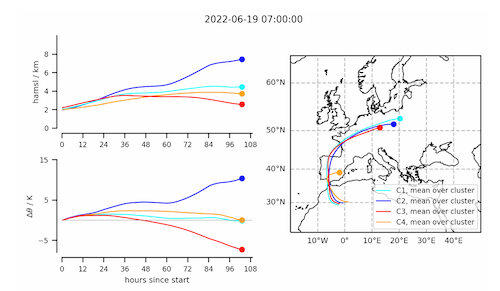
The Atmospheric Deserts project is carried out by Fix-Hewitt together with her supervisor Prof. Georg Mayr, master’s student Jana Schitthof, and collaborators from the Statistics Department at the University of Innsbruck. Their goal is to better understand how Saharan air changes during transport and how its interaction with European air masses affects temperature extremes and thunderstorm formation – knowledge that could improve future weather prediction.
Read more in the original article – interview with Fiona Fix-Hewitt by EuroCC Austria
(Announcement first posted on 16.12.2025.)