
19.02.2026
ASC review 2025
The highlights of infrastructure updates, HPC usage, and training at Austrian Scientific Computing (ASC).
In 2025, Austrian Scientific Computing (ASC) continued the core task of operating, maintaining, and developing Austria’s national high-performance computing infrastructure. The year saw substantial infrastructure updates, the integration and testing of new systems, steadily rising usage, and an expanded training program that reached a broader audience than in previous years.
Together, these activities reflect how ASC supports research, industry, and public institutions on a day-to-day basis – through reliable systems, expanding resources, and practical knowledge transfer.
From VSC to ASC
In 2025, Vienna Scientific Cluster (VSC) was renamed Austrian Scientific Computing (ASC). You can read the official statement on the name change here. Along with the new name, we introduced a new visual identity, including an updated logo.
Infrastructure updates
A major focus in 2025 was infrastructure renewal. ASC deployed a new storage system with a total capacity of 40 PB, including 10% NVMe flash storage. This represents a substantial increase compared to the previous system, which provided approximately 6 PB and had reached end of life. The new platform is based on the IBM Storage Scale filesystem and consists of four IBM Storage Scale System 6000 appliances. It provides a more scalable and resilient storage environment to meet current demands and anticipated future growth across ASC systems.
The ASC software stack was further expanded with additional toolchains and a broader software pool, supporting a wider range of HPC and AI workloads. In parallel, preparatory work for ISO 27001 certification began, reflecting increased attention to information security.
Work on MUSICA, Austria’s next-generation supercomputer, continued throughout 2025. Hardware installation was completed in Vienna, Innsbruck, and Linz. Due to technical challenges, the system did not enter production in the time originally planned. However, the system is now close to the launch, with the acceptance tests completed and the open test phase ongoing, during which system stability, performance, and software integration are being further evaluated.
At the same time, ASC continued operating VSC-4 and VSC-5, ensuring uninterrupted service for users while preparing MUSICA for the roll-out.
First MUSICA success stories
During MUSICA’s test phase, several projects already made use of the new hardware, demonstrating capabilities of the new system:
- A team at TU Wien, in collaboration with the supercomputing competence center EuroCC Austria, trained a large language model to analyze and classify TU Wien’s research fields.
- A team at University of Innsbruck and EuroCC Austria used HPC resources to train vision models on butterfly recognition with the largest public dataset of butterfly images, supporting biodiversity and conservation research.
Usage and energy consumption
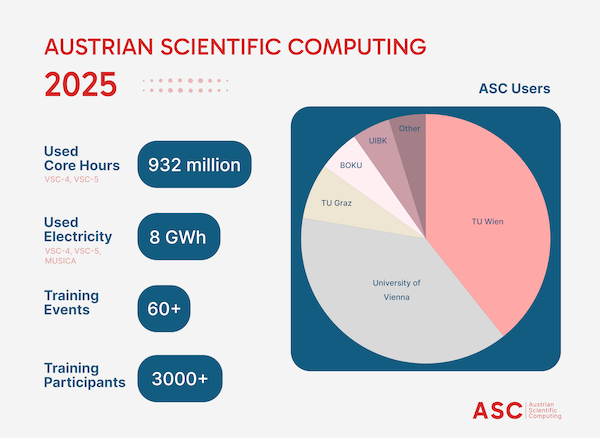
In 2025, demand for ASC systems continued to increase. Our users consumed 932 million core hours on VSC-4 and VSC-5. Core hour usage on MUSICA in 2025 is not yet included, as the system remains in the test phase.
For comparison:
2024: 907 million core hours (VSC-4 and VSC-5)
2023: 710 million core hours (VSC-4 and VSC-5)
Total electricity consumption across VSC-4, VSC-5, and MUSICA amounted to approximately 8 GWh.
For comparison:
2024: 6,4 GWh (VSC-4 and VSC-5)
2023: 5,5 GWh (VSC-4 and VSC-5)
The increase in 2025 reflects the continued operation of existing systems alongside the installation and testing of MUSICA, the deployment of a significantly larger storage system, additional clusters reserved for research groups, and the supporting infrastructure required to run them.
Training
Training remained a central pillar of ASC’s activities in 2025. Over the course of the year, ASC organized 60+ training events with more than 3,000 participants, almost doubling participation compared to the previous year.
Together with partners such as EuroCC Austria, AI Factory Austria AI:AT, NVIDIA, OpenACC, HLRS, LRZ, NHR@FAU, and European competence centers, ASC covered a broad range of topics – from core HPC subjects like MPI, OpenMP, CUDA, hybrid programming, and GPU programming to AI-related topics including large language models, trustworthy AI, and AI applications in science and industry.
Participants came from universities, research institutions, public organizations, and companies, reflecting the diverse user base that relies on ASC systems and expertise. A particular highlight in 2025 were four joint bootcamps organized with international partners, which became the largest collaboration of the year. Read a recap of the bootcamps here.
Collaborations
Collaboration remained an integral part of our work in 2025. ASC continued its close cooperation with the supercomputing competence center EuroCC Austria and Advanced Computing Austria ACA GmbH, particularly in supporting companies’ access to HPC resources, expertise, and training. Through this collaboration, industrial users were able to explore high-performance computing as a practical tool for research, development, and innovation, often for the first time. For insight into the user projects, see EuroCC Austria's blog.
At the European level, ASC has been contributing to several projects, including EuroCC – a network of 30+ HPC competence centers and Centers of Excellence, EVITA – focused on building training, and EUMaster4HPC – focused on educating the new generation of HPC experts.
ASC also remained active in RI-SCALE, project that supports data-intensive research with a wide range of advanced computing services, and in the community of Women in HPC – Central European Chapter. In parallel, ASC supported national activities related to Austria’s participation in the European Open Science Cloud (EOSC), contributing expertise in infrastructure, data services, and interoperability.
In addition, work within the CASTIEL project continues until mid-2026, supporting coordination and knowledge exchange across the European HPC network.
2025 also saw the launch of AI Factory Austria AI:AT. ASC is working closely with the AI:AT team, contributing technical expertise to the preparation and procurement processes for the planned AI Factory supercomputer. This collaboration builds on ASC’s experience in operating large-scale systems and complements its ongoing role in national HPC infrastructure.
Outlook for 2026
In early 2026, ASC plans to bring MUSICA into regular operation. VSC-4 and VSC-5 will remain in service, resulting in three operational systems available to users. Preparations for the procurement of the AI Factory Austria supercomputer will continue alongside regular operations.
ASC continues to offer a broad training program consisting of workshops, courses and webinars. See the training calendar here.
On 7–10 April 2026 ASC will host the Austrian-Slovenian HPC Meeting 2026 (ASHPC26). Call for abstracts is open until 22 February, registration is open until 29 March. See more information here.