
03.07.2026
Supercomputer MUSICA goes into operation
Austria's most powerful supercomputer advances research, AI development, and innovation.
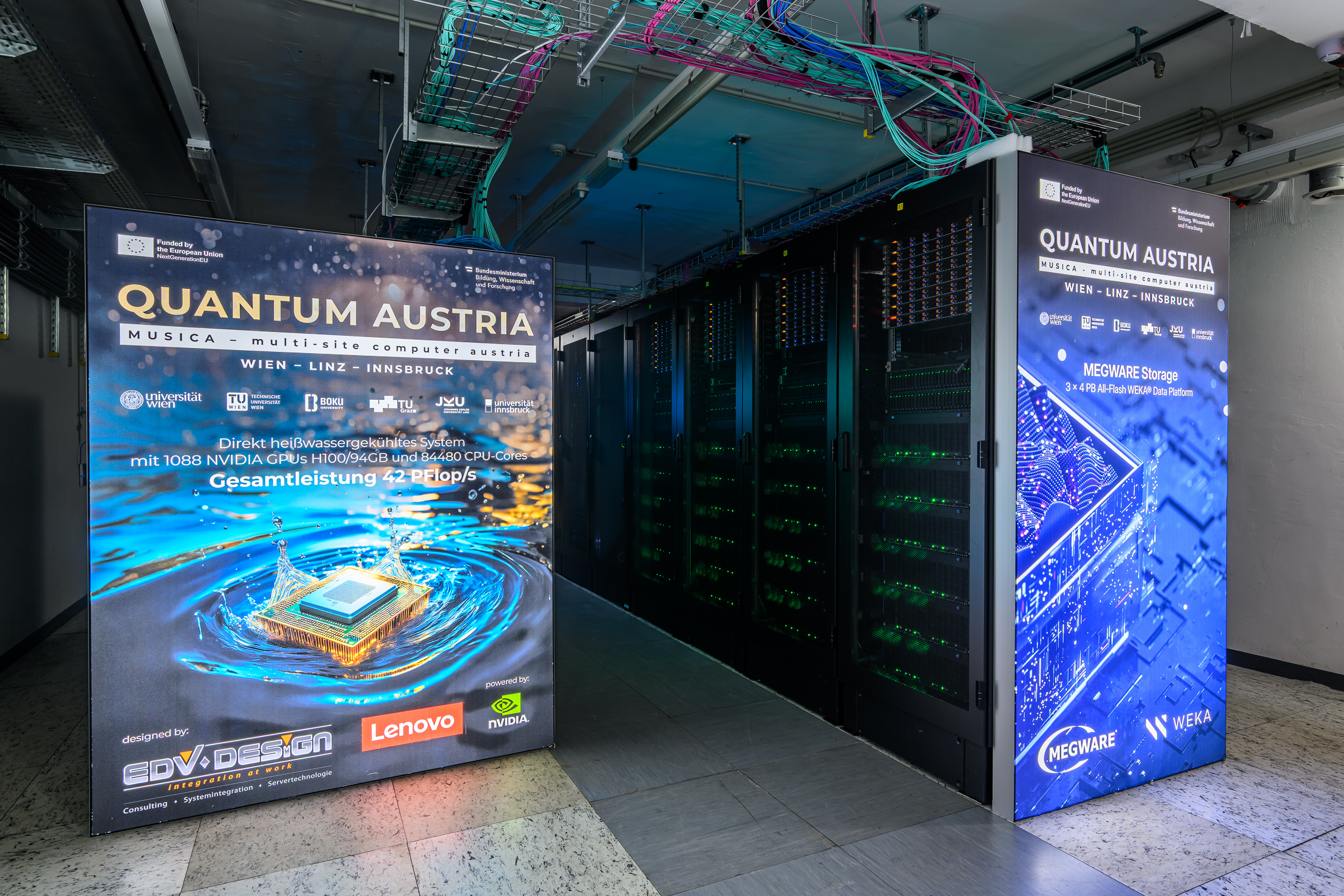
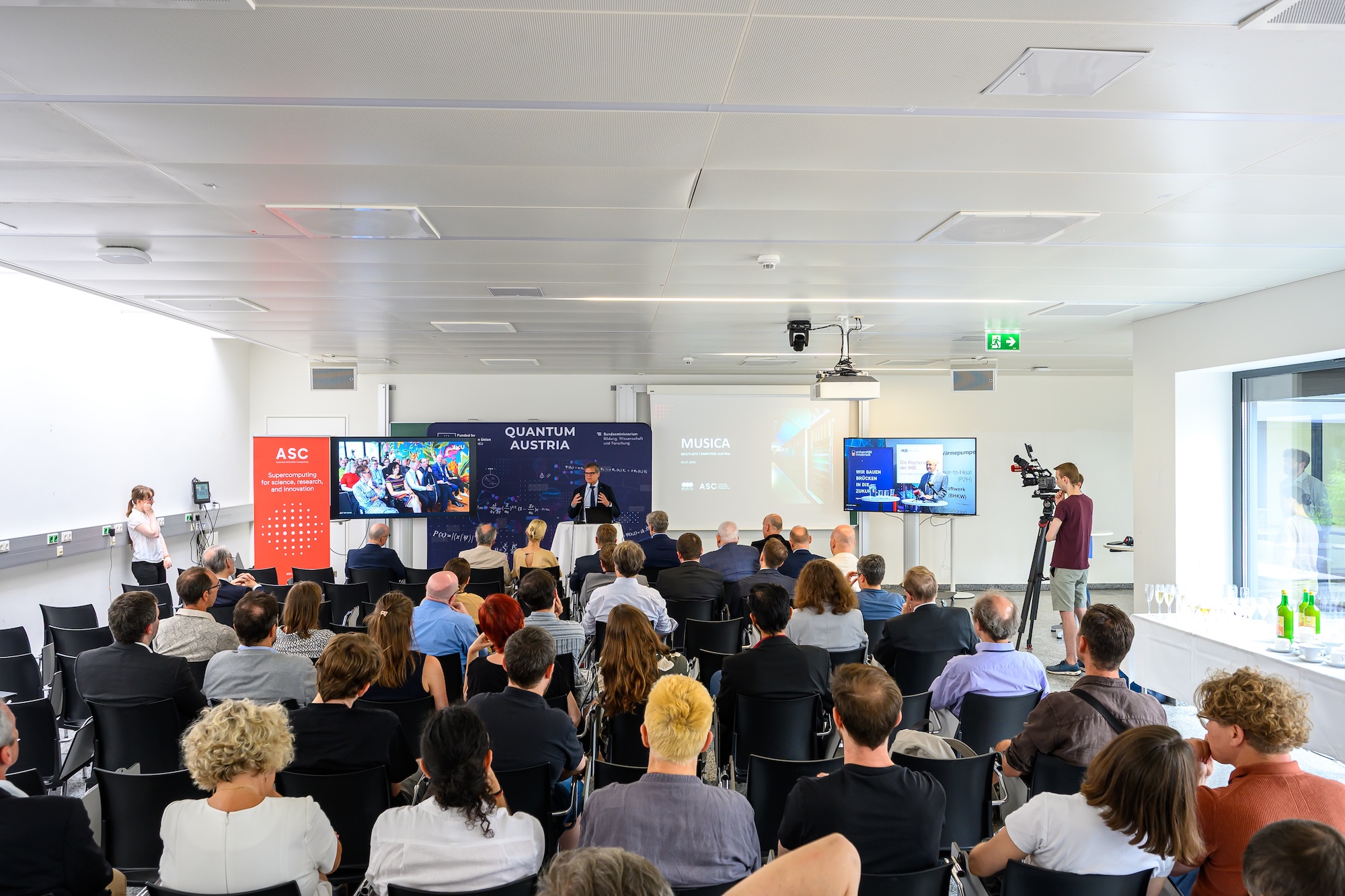
Austria's new high-performance computing (HPC) system, Multi-Site Computer Austria (MUSICA), was officially inaugurated on July 3, 2026.
With MUSICA, Austria's national computing capacity increases significantly. The system provides the computing power for science, research, industry, and public institutions to remain internationally competitive.
Built for AI and data-intensive research
MUSICA is currently ranked among the TOP100 fastest supercomputers worldwide in the TOP500 ranking. With an aggregated performance of 45.11 PFlop/s, MUSICA delivers more than eight times the performance of two other Austria's flagship national supercomputers, VSC-4 and VSC-5.
Designed as a versatile system, MUSICA supports both traditional high-performance computing (HPC) workloads and large-scale artificial intelligence applications. Equipped with more than 1,000 NVIDIA H100 GPUs, the system provides the computational power required to train modern machine learning models and large neural networks. At the same time, it enables advanced simulations and data-intensive workflows in fields including physics, engineering, chemistry, life sciences, and environmental research.
Computing power for science and industry
MUSICA is available to research institutions, businesses, and public sector organizations. Researchers at the partner universities have free access to the system, while other users can access computing resources through pay-per-use models. More about rules of access here.
"MUSICA delivers exactly what Austria's strategic objectives call for: competitiveness, excellence, and innovation. What is essential now is stable funding for operating costs to ensure that this major investment delivers world-class performance across the entire HPC sector," says Nikolaus Hautsch, Chair of the ASC Steering Committee and Vice Rector for Infrastructure at the University of Vienna.
HPC meets Quantum Computing
MUSICA also provides access to Austria's first production-ready quantum computer.
"With the OTTER trapped-ion quantum computer and tailored training programs, we are expanding ASC with a third key technology for scientific computing. High-performance computing, artificial intelligence, and quantum computing at an international level together create a flagship infrastructure within the European research landscape. This makes one thing clear: if university budgets are cut, the impact will extend beyond HPC and AI—it will also significantly affect the operation and continued development of Austria's first quantum computer," notes Gregor Weihs, Vice Rector for Research at the University of Innsbruck.
Seven partners, three sites
MUSICA is the result of many years of successful collaboration between Austrian universities and research institutions within the Austrian Scientific Computing (ASC) consortium (formerly known as the Vienna Scientific Cluster, VSC).
Project partners are TU Wien (project coordinator), the University of Vienna, BOKU University, the University of Innsbruck, Graz University of Technology, and Johannes Kepler University Linz. The consortium's newest member is the Institute of Science and Technology Austria (ISTA), which supports the continued expansion of the infrastructure.
"Universities are the roots from which humanity's knowledge and progress grow. That requires collaboration, and MUSICA is an excellent example of what such cooperation can achieve. The supercomputer is available to researchers throughout Austria, enabling our scientists at JKU Linz to conduct internationally competitive research using state-of-the-art IT infrastructure. I am grateful to everyone whose initiative made this project possible," says Alberta Bonanni, Vice Rector for Research and International Affairs at Johannes Kepler University Linz.
"MUSICA is not only by far the largest supercomputer in Austria. It is a clear commitment by policymakers to Austria as a center of research, a flagship of inter-university collaboration, and an unprecedented driver of data-intensive research and AI development. Its extraordinary computing power enables the next generation of simulations, data analytics, and large neural networks, delivering immediate benefits for the life sciences, environmental sciences, industry, and public institutions," says Christoph Pfeifer, Vice Rector for Research and Innovation at BOKU University.
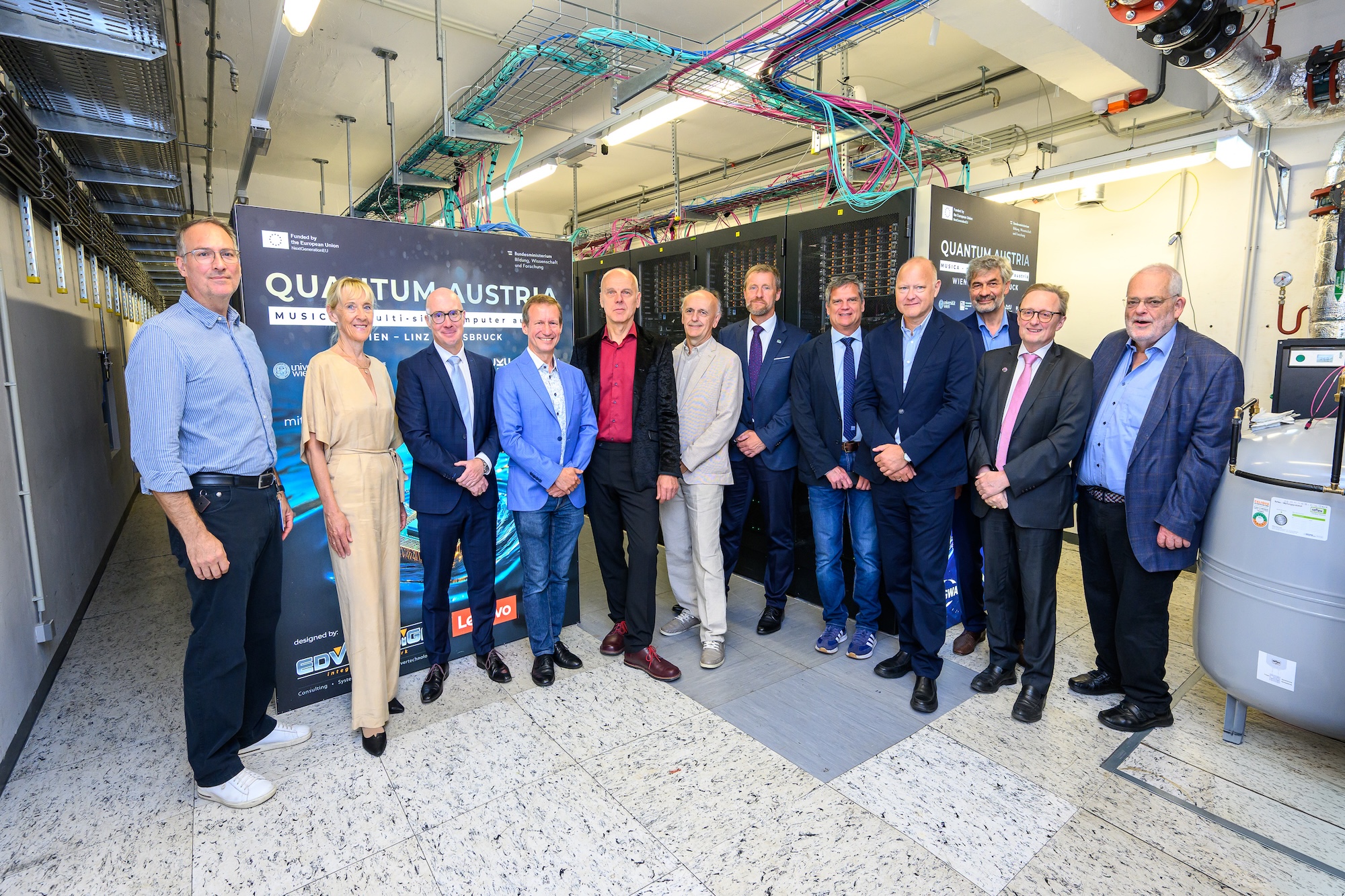
Left to right: Vice Rector Peter Ertl (TU Wien); Federal Ministry of Education, Science and Research (BMFWF) Director General Barbara Weitgruber; Vice Rector Nikolaus Hautsch (University of Vienna); Head of ASC Andreas Rauber (TU Wien); ASC Technical Director Ernst Haunschmid (TU Wien); former Vice Rector of TU Wien Johannes Fröhlich; Head of Division SSUs Roland Gansch (ISTA); Rector Jens Schneider (TU Wien); Head of Unit Stefan Hanslik (BMFWF); Vice Rector Gerhard Mannsberger (BOKU University); Daniel Weselka (TU Wien); Herbert Störi (TU Wien) © TUW/ASC/Matthias Heisler
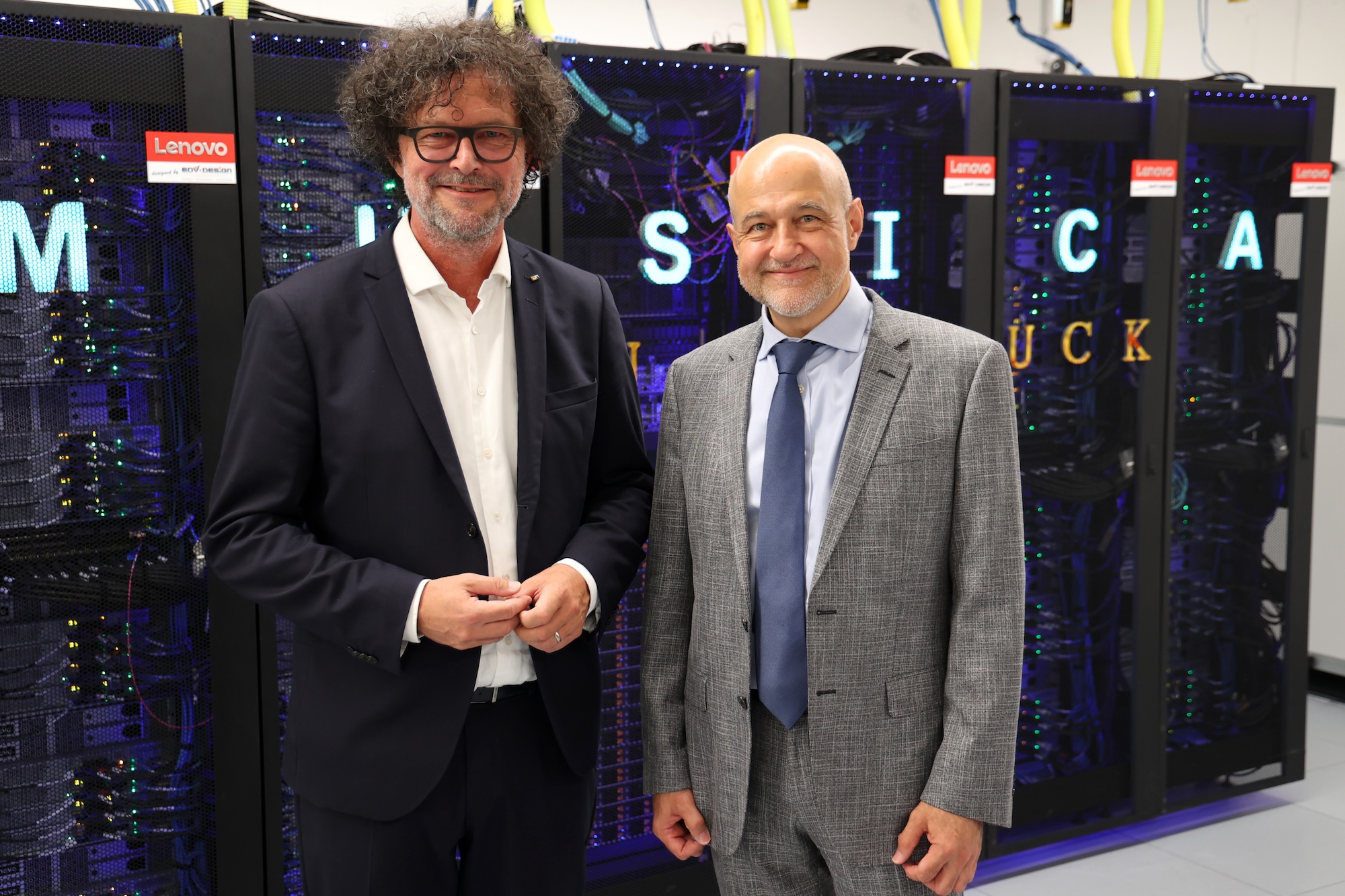
Left to right: CEO of IKB Thomas Pühringer, Vice Rector of the University of Innsbruck Gregor Weihs © University of Innsbruck
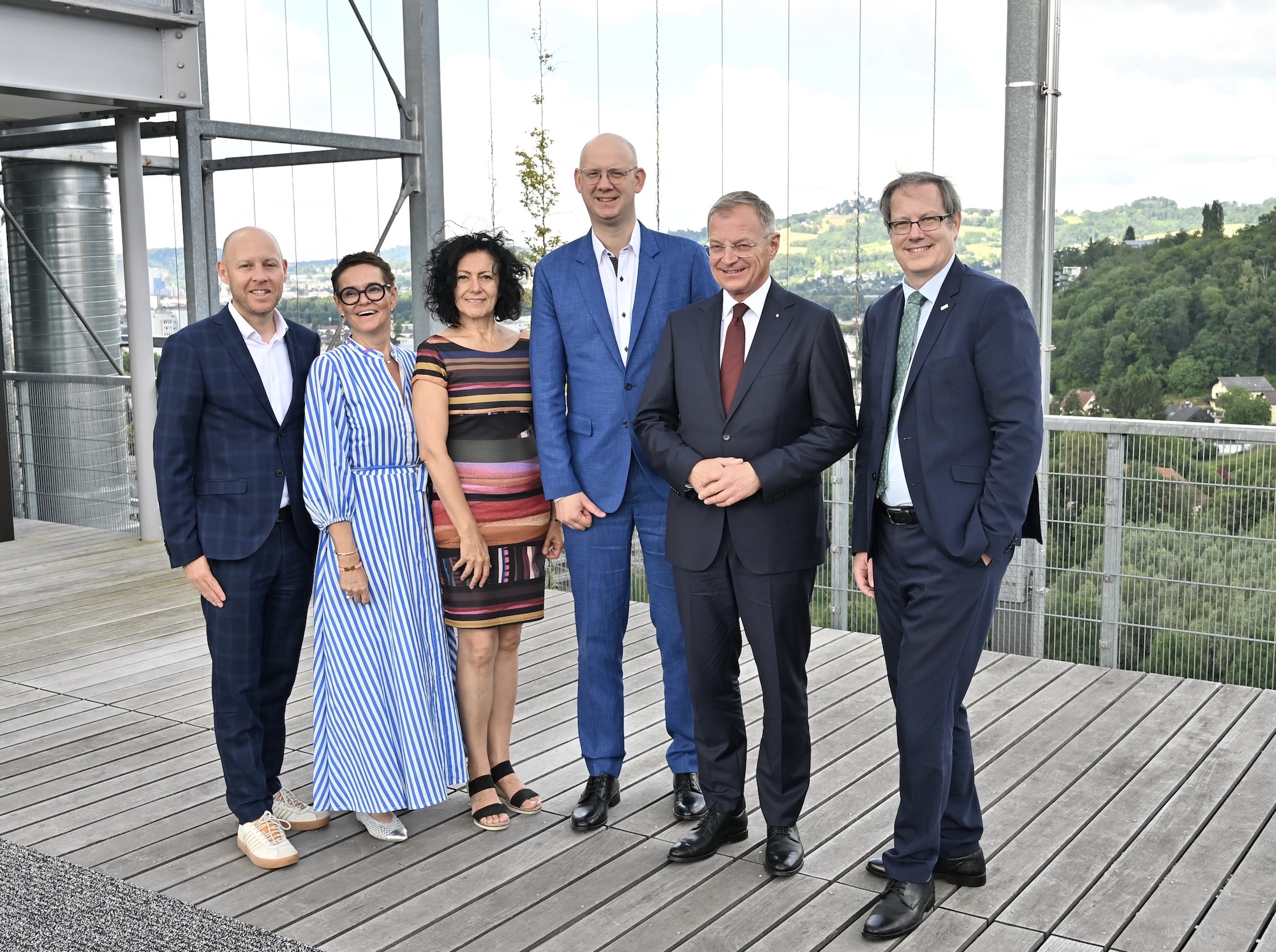
Left to right: Vice Rector of JKU Alexander Freischlager; Vice Rector Christiane Tusek; Vice Rector Alberta Bonanni; City Councillor of Linz Thomas Gegenhuber; Governor of Upper Austria Thomas Stelzer; Rector of JKU Stefan Koch © JKU
One of MUSICA's defining features is its multi-site architecture. The system is distributed across three locations: TU Wien's Science Center in Vienna, the University of Innsbruck, and Johannes Kepler University Linz. All components are centrally configured and managed, yet can operate either as a single high-performance system or independently. This architecture increases operational resilience and flexibility while ensuring that computing jobs can continue even if one site experiences limitations.
"MUSICA brings together two worlds that are increasingly converging in modern science: large-scale simulation and AI-driven data analysis. Equipped with 1,088 high-end GPUs and integrated cloud services, the system provides the performance and flexibility needed for the next generation of scientific computing and AI development. Reliable, predictable funding for MUSICA's operation through adequate university budgets is essential to ensure that this world-class infrastructure can achieve its full impact," said Andreas Rauber, Head of the ASC Research Center.
Energy-efficient high-performance computing
Energy efficiency was a key design criterion for MUSICA. Most of the system uses direct hot-water cooling, with cooling elements attached directly to processors, GPUs, and memory modules. This enables year-round free cooling, significantly reducing energy consumption compared with air-cooled systems.
Investing in future technologies
"MUSICA is a milestone for Austria as a center of research. The supercomputer provides the foundation for ensuring that cutting-edge research, artificial intelligence, quantum technologies, and innovation can continue to thrive at the highest international level. Shaping the future requires investing in the infrastructure that makes it possible today. Research drives progress—for better healthcare, climate protection, innovative jobs, and a better quality of life for everyone. MUSICA therefore strengthens not only Austrian research, but also Europe's technological sovereignty," says Eva-Maria Holzleitner, Federal Minister for Women, Science and Research (BMFWF).
Funding
MUSICA received €20 million in funding from the Austrian Research Promotion Agency (FFG) through Quantum Austria and the European Recovery and Resilience Facility, with an additional €16 million provided by the Federal Ministry for Women, Science and Research (BMFWF).
Technical specs for MUSICA at locations in Vienna, Linz, and Innsbruck

- Performance:
45.11 Pflop/s (aggregated, Rmax)
TOP100 worldwide (as of June 2026)
- Compute resources:
1,088 NVIDIA H100 GPUs
880 AMD EPYC CPUs
768 GB RAM per node
- Storage:
WEKA Data Platform
12 PB all-flash storage
1,800 GB/s read throughput
750 GB/s write throughput
- Architecture:
Distributed HPC system
Sites: Vienna, Linz, Innsbruck
MUSICA inauguration press release (German)
(Announcement first posted on 03.07.2025.)