
29.02.2024
Climate modeling on VSC – access for students
Students at the University of Vienna receive access to the VSC supercomputer to run the global climate model ICON.
Modern climate models simulate many components of the climate system, such as clouds, precipitation, winds in the atmosphere, ocean circulation, vegetation, as well as the sources and sinks of greenhouse gases and all their mutual interactions. As a result, they rank among the most resource-intensive applications that can be run on modern High-Performance Computing (HPC) systems.
The latest km-scale models, which are currently being developed, require large parallel computational resources, generally exceeding hundreds of compute nodes. In exchange, they set new standards for the number of processes that can be resolved and provide output in ever higher resolution.
VSC access
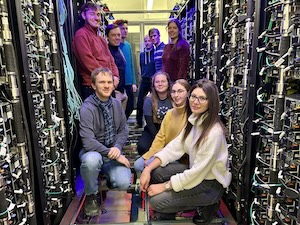
At the Department of Meteorology and Geophysics, University of Vienna, a concerted effort is underway to equip students with HPC skills crucial for mastering climate modeling software and workflows.
In the  Modelling and Data Analysis course led by Lukas Brunner, Blaž Gasparini, and Daria Tatsii, the students learn how climatic processes are simulated in a computer model. To enhance their knowledge with practice, in the winter semester 2023, the students were given access to the HPC infrastructure of the Vienna Scientific Cluster (VSC).
This way, they had a chance to practice advanced simulations with ICON – a highly versatile atmospheric model for global and regional weather and climate simulations. They learned how to set up and run the ICON model and analyzed the output of their simulations.
Results
The resulting simulations provided insights into how much of global climate change is attributed to changes in carbon dioxide concentrations and how much to increases in temperature. In the real world, the two effects are interrelated and can thus only be separated and studied using climate models. Despite initial troubles in making the climate model compile and run, students enjoyed learning about the fundamentals of climate science in a practical, hands-on setting.
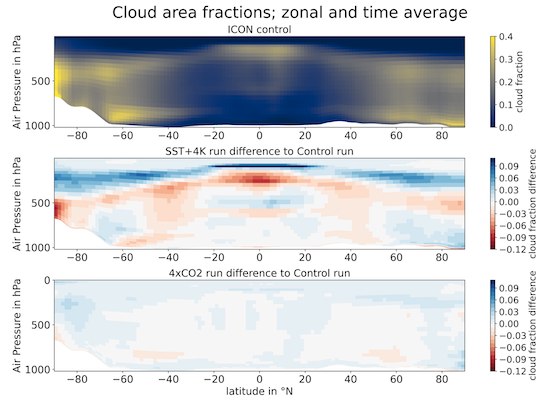
Cloud fraction at different altitudes from 3 different model simulations using the ICON model:
(top) control run with standard conditions, (middle) run with the sea surface temperature increased by 4°C (but CO2 kept constant) and (bottom) run with CO2 quadrupled (but sea surface temperature kept constant).
© Mixan, Haumer & Schuhbauer
Prepared for real-world challenges
The VSC access was not only an excellent opportunity to learn state-of-the-art climate models but also to encounter the typical challenges that the research community is dealing with at the present moment, including the scientific staff at the Department of Meteorology and Geophysics at the University of Vienna.
The Climate Dynamics and Modeling group, for example, is currently in the process of porting the km-scale version of ICON at VSC. For meaningful research, this requires at least 100 parallel nodes, which only high-performance computing centers, such as VSC, are able to provide.
Afterword
The VSC access for students was facilitated by EuroCC Austria – National Competence Centre for Supercomputing, Big Data and Artificial Intelligence. Together with EuroCC Austria, VSC supports the next generation of HPC users who are confident in using sophisticated tools to tackle complex problems in climate research and other fields of science.
This is the second time VSC collaborated with Lukas Brunner, Blaž Gasparini, and Daria Tatsii.
Last year, their students used VSC to work with the climate model CESM2. You can read about it here.
(Announcement first posted on 29.02.2024.)